23rd March, 1984 Windsurfer Rescue & R.N.L.I. Award
A 30 minute video presentation of this story is available via the button below.
In the early 1980’s windsurfing was a new sport enabled by the technology of modern fibre-glass available for the sailboard construction and lightweight strong materials for the mast and sail. Windsurfers were pushing the boundaries by going out in ever wilder weather conditions. In the 21st century they are a familiar sight in windy conditions, often with kites towing them along.
On Friday evening 23rd March 1984, at around 6.00 p.m., the Fleetwood lifeboat was called out to assist a windsurfer who was reported to be in trouble off the shore towards Blackpool. Near Gale force conditions existed at the lifeboat station with the wind direction from the South East, and it was well sheltered from this direction at the lifeboat station launching point. The tide was about 2½ hours after high water and at that time of year there was around one further hour of daylight. Because it would be dark within the hour and expecting some shelter from the land due to the south-easterly wind direction I decided to use the faster inshore lifeboat. At this state of tide there would still be enough water in an inshore passage called ‘The Neckings’ before it dried as sandbanks again within one hour. Using the inshore lifeboat would save some 45 minutes in time against getting the offshore lifeboat to the reported location of the casualty, having to go around the Wyre Channel and Lune Deeps.
The geography of the area is shown in the chart and although it was time saving there was risk in using the inflatable inshore lifeboat. The parting conversation at the lifeboat station was “Prepare to back me up with the offshore lifeboat”. There was sufficient water in The Neckings but as we approached Rossall Point the sea became rougher with short breaking seas, caused by the wind over tide effect in the relatively shallow water.
Off the Western edge of the sandbanks at Rossall Point the seas were very rough with breaking waves around six to eight feet high and at the operating limits for the inshore lifeboat.
Rounding the Point we altered course to turn south towards the reported position of the casualty. With the weather deteriorating, the south-south-easterly wind had increased to gale force 8; gusting severe gale force 9, with eight to ten foot seas and a moderate to heavy swell and the inshore lifeboat was experiencing the full force of wind and sea.
As we rounded the Point we realised the severe state of the sea. If you had been kneeling beside us on the deck-pad of the lifeboat looking at the cresting seas that lay in our path you would have been filled with a sense of foreboding as we were continually stung in the face by icy spray blown from the tops of the waves. In hindsight it was at this point I should have summoned assistance from the offshore lifeboat but at 25 years old I believed I could do the job and continued unaided. Throughout the passage south from the Point the lifeboat was being buffeted by rough seas. The heavy spray thrown up together with the rise and fall of the sea swell meant that visibility from the low vantage point of the inflatable boat was poor and probably not more than 50 metres. We were trying to get to the casualty position as quickly as possible but with breaking white topped seas it was necessary to slow the engine to ride these waves. We arrived at the reported position at around 18.15 hours. Close radio contact was being maintained with the Coastguard mobile officers’ on the beach, who were trying to keep the sailboard under observation but as daylight was diminishing they were having difficulty in spotting the windsurfer in the increasing seas.
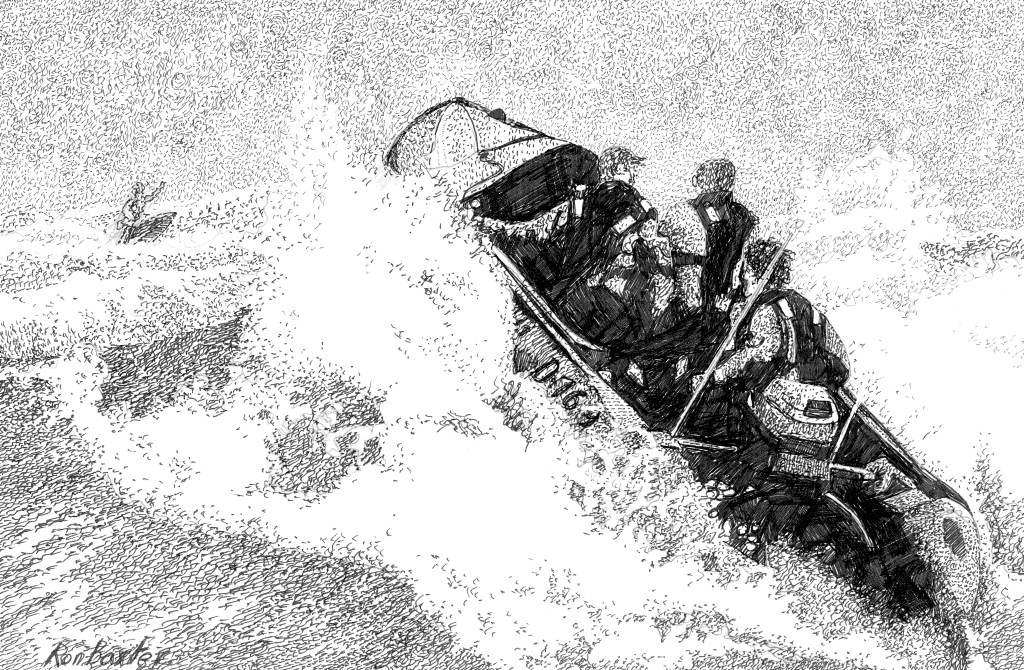
| As the inshore lifeboat lifts on one wave the windsurfer was spotted on another wave crest around 200 metres away |
As we were just asking for an update from the coastguard on our relative position to the windsurfer and now on the edge of darkness, the inshore lifeboat was lifted up on a high wave crest and fortuitously we caught sight of the sailboard being similarly lifted by a wave some 150 metres further out to sea, and at a distance of approximately one mile from the shore. At this moment we felt elated as we had been feeling alone and isolated amongst the breaking seas.
The survivor was sitting astride his board, which was being taken rapidly out to sea by the wind and tide. Although extremely exhausted he was still able to cling to his sailboard, and raised a hand to attract our attention in acknowledgement of seeing us as we approached him. He had already jettisoned his mast and sail. In the weather conditions there were serious risks of damaging the inflatable lifeboat if an attempt was made to take the man off the sailboard. The board sailor was wearing a dry suit and a buoyancy aid so I shouted across telling him to slip into the water and push himself clear of his board. This the man did and, as the lifeboat came alongside, he was quickly pulled on-board by the crew members.
For additional safety he was helped into a survivor’s lifejacket on-board the inshore lifeboat. The board was then recovered, at the first attempt, and lashed to the top of the lifeboat’s side sponson. The difficult decision facing us now was how to get safely back to the lifeboat station. The weather was now bad and the seas increasing and continually breaking. Two distinctly different options faced us; either head straight for the beach around 1 mile east of us and risk losing both the lifeboat and the survivor in the surf as we approached the shore, or commit to the long way back to the lifeboat station around the outside of the sandbanks of the southern shore of Morecambe Bay.
It is in the tempest of a difficult situation and when the adrenalin is flowing inside you that your inner voice as the whisper of instinct and a lifeboat coxswains friend speaks to you in helping you reason with yourself logically to choose the right pathway to recover the situation.
Because the sailor was well clad and a seemingly fit young man, I discussed our predicament with the crew and decided that trying to run the lifeboat up the beach on the nearest shore was an unnecessary risk as we could be overturned in the surf; it would be better to go back the long way, as The Neckings channel would be drying out by this time. The Coastguard mobile officer confirmed that, with the falling tide and rough water, The Neckings was no longer navigable, so we committed ourselves to the long way home.
It was now fully dark and the inflatable lifeboat was becoming sluggish at steering with an extra person on board and water in the bilge that had splashed on-board during the outward journey. The seas were too rough to drive her at full power so that she could drain off the water through her self-bailer. Essentially – the outboard engine kept going but only slow progress was made due to now following seas. At one point a large following sea picked us up and we surfed down it causing the bow to become submerged and water rolled over the forward canopy, more than half filling the lifeboat, soaking us beneath our oilskin suit to above our waists. The boat can cope with being filled with water and not sinking but there is a self-baler that should drain water out through a tube-pipe at the stern. However, you need to have some forward movement to make it effective and it was difficult to get any speed up with the large following seas to cope with. It was hard to control the heavy boat in the rough seas to stop the lifeboat being capsized but we were able to continue back towards Fleetwood.
Once round the entrance to Morecambe Bay and turning on to an east-north-easterly course, some respite was afforded by the shelter of the sandbanks. Entering the River Wyre Fleetwood main channel, and turning south-south-east for home, speed could be increased and the majority of the water was drained from the boat. A feeling of relief came over us as we knew we had made it back into the safe waters of the Fleetwood approaches and had saved the life of this windsurfer who would have undoubtedly been lost as darkness fell had we not taken the shortcut to get to his reported position.
In formal terms the records show that ‘at 19.20 the inflatable lifeboat arrived back at station, where the board sailor and his board were landed. The lifeboat was re-housed and once again ready for service at 19.30’. In personal terms the three of us collectively felt – a good job done.
For this rescue service the service award of the RNLI was presented to me as helmsman of the D class inflatable lifeboat. Vellum service certificates were presented to crew members Barrie. E. Farmer, and David B. Owen. Subsequently, on the 26th June 1985 the RNLI Committee of Management conferred the Ralph Glister award on me and the two crew members crew members for ‘the most meritorious service and bravest act of lifesaving carried out in a lifeboat under 10 metres, in the UK, in 1984’.
As implied in these outlines of rescue ‘jobs’ over my twenty three years in the life-boat service I have made my own mistakes and learned lessons on every occasion. Overall I would like to feel that I have made a positive contribution and my Certificate of Service with the R.N.L.I. states that during my time over more than two decades with Fleetwood Life-boat station 215 lives were saved.
 Fleetwood Lifeboats Past