Cistus Yacht Crew Rescue by Fleetwood Lifeboat on June 2, 1956
Information from coverage in Fleetwood Chronicle newspaper June 8 edition via David Pearce 01235 778668
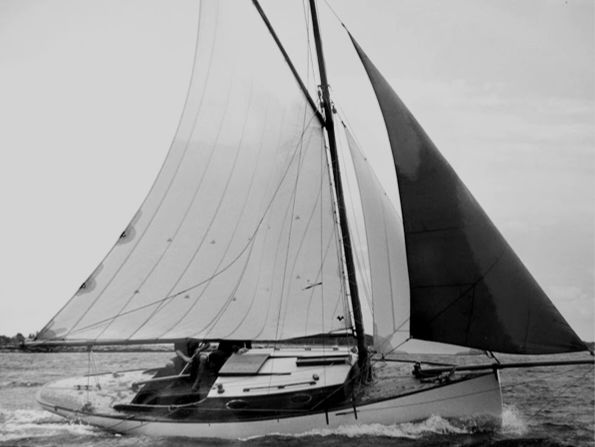
In the early hours of June 2, 1956 a yacht called Cistus was approaching Fleetwood on passage from the Isle of Man.
Onboard was the skipper and owner Norman Clifford Brown of Moore Street, Rochdale, a member of the Fleetwood and Blackpool Yacht Club. Previously he had put in a good performance in the Fleetwood – IOM yacht race. Aged 50 he was manager of the Heywood Steel Works and had spent money on having Cistus converted to leisure use. Originally she was a Fleetwood prawner 37 feet long and 16 tons.
About half way up the Wyre channel Cistus hit a lighted buoy and rapidly began to fill with water.
Norman went into the cabin for a lifejacket but the door jammed shut trapping him inside.
His son Gerald managed to open to door and dragged his father out.
Almost immediately they were in the water along with two companions – Errol Howarth, aged 18 and Clifford Moss of similar age – both of Rochdale.
Gerald, known as Gerry, told them to swim for a green light – the Black Scar navigation perch – but they were quickly separated in the fast running tide.
Gerry thought his father had drowned.
Gerry got ashore near the old lifeboathouse and was seen on the Promenade by a passing police car which took him to Fleetwood hospital.
Errol landed near the pier and his cries for help alerted the night watchman. He was taken to Fleetwood hospital.
Tied up at the North End Quay were three ships – the Isle of Man steamer Tynwald, the Fleetwood dredger Rossall and the ICI coaster Sodium.
Lifeboats were launched from all three ships. The Rossall’s boat found young Clifford Moss afloat in the river but semi-conscious. He was taken to Fleetwood hospital.
The Fleetwood lifeboat (Relief lifeboat Edmund and Mary Robinson) searched up river.
Two miles from the scene of the sinking the lifeboat crew found Norman Clifford Brown floating near the river bank on the powerful flood tide.
He was kept afloat by his lifejacket and had been in the water for two hours. He was nearly strangled by cords on the lifejacket.
After first aid from the lifeboat crew he was taken to Fleetwood hospital.
All four men recovered.
Cistus looked ready to break up but was moved to a better position on the sands by a team from Fleetwood docks. Her fate is unknown.
David Pearce talked to a local yachtsman about the Cistus incident which he recalled very clearly based on what the owner, Norman Clifford Brown (often known as NC) told his friends at the Fleetwood and Blackpool Yacht Club when he got out of hospital.
My informant was a teenager then, very keen on sailing with his dad and others from Skippool. He remembers NC’s favourite tipple was a Guiness with a rum chaser.
NC and his son Gerald were often accompanied in Cistus by young crewmen who worked for NC at the Heywood steel works.
The boat had been for sale in Conway before NC bought her.
On the fateful night they sailed Cistus from the Isle of Man to Fleetwood with NC on the tiller as he entered the Wyre channel and passed Wyre Light. The wind was from the west filling the main sail (Cistus was gaff rigged) and tending to push the boat to port towards the red channel buoys on the Knott End side of the channel.
NC could not see the red buoy lights because he was standing on the weather side of the main sail so he sent the two young crewmen up for’ard and told them to ‘sing out’ when they saw a red light on the port bow.
He never heard a shout from them later claiming they had not been paying attention. Next minute he hit the buoy.
According to this yacht club version of events NC must have spoken to lifeboatmen later – hopefully to thank them.
He said he was told that, as the lifeboat sailed up the Wyre looking for him it was beginning to get light. The Coxswain (Albert Wright according to Heroes of the Waves) saw a flock of birds ahead circling towards the Over Wyre side and told the crew: That’s where he is.
Sure enough NC was barely afloat and barely alive below the birds.
The badly damaged Cistus lay on the sandbanks on the Knott End side for some days and was then taken up to Skippool. She was made temporarily watertight for the journey by stretching a canvas over the damaged hull with ropes and sealing it down with tar.
At Skippool she was fully repaired and was last heard of sailing in the Med after NC sold her to a new owner.
David Pearce, August 2024
 Fleetwood Lifeboats Past